
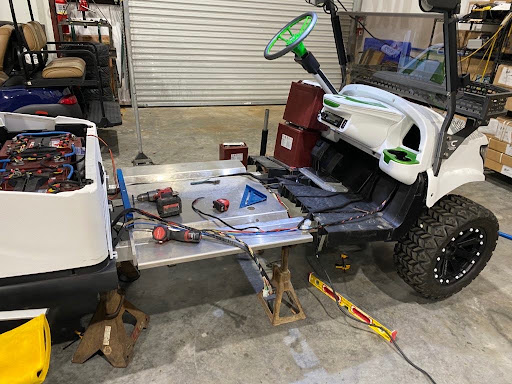
A golf cart that suddenly feels slower, weaker, or less responsive than usual is usually telling you that something in the system needs attention.
Maybe it still drives fine on flat ground but struggles going uphill. Maybe acceleration feels sluggish. Maybe it loses speed when you add passengers, or the battery gauge drops much faster than it used to. In other cases, the cart may run normally for a short period before performance begins to fade.
At Dynamic Drives & Design, we work with golf cart owners throughout Jacksonville Beach, Jacksonville, Ponte Vedra, Neptune Beach, Atlantic Beach, and surrounding Northeast Florida communities. Whether you use your cart around the neighborhood, near the beach, for local transportation, or as part of your day-to-day routine, a noticeable loss of speed or power is worth diagnosing before the problem gets worse.
A golf cart losing power can be caused by several different things, including weak batteries, poor cable connections, controller issues, motor problems, low tire pressure, dragging brakes, charging problems, or simply carrying more weight than the cart can comfortably handle.
Weak or Aging Batteries Are Often the First Place to Look
For electric golf carts, battery condition is one of the most common causes of poor performance.
As batteries age, they can begin losing their ability to deliver consistent power under load. The cart may still turn on and drive, but it may not accelerate as quickly, climb hills as well, or maintain the same range it once did.
Golf cart owners in Jacksonville and Jacksonville Beach often notice this first when the cart is carrying several passengers or traveling over inclines. A weak battery pack may feel almost normal on flat pavement but struggle when the motor has to work harder.
You may also notice that the battery gauge drops quickly, the cart takes longer to charge, or the driving range becomes noticeably shorter.
At Dynamic Drives & Design, we can evaluate the battery system and help determine whether the issue is related to battery age, charging, a weak cell, or another part of the electrical system.
Loose or Corroded Battery Cables Can Reduce Power
Even if the batteries themselves are healthy, poor electrical connections can cause a noticeable loss of performance.
Loose terminals, damaged cables, corrosion, or worn connectors can create resistance in the electrical system. That resistance limits the amount of power reaching the controller and motor, which can lead to slower acceleration and inconsistent performance.
In Northeast Florida, heat, moisture, humidity, and outdoor use can all contribute to corrosion over time. Golf carts used around Jacksonville Beach, Neptune Beach, Atlantic Beach, and Ponte Vedra may also be exposed to salty coastal air, which makes regular inspection even more important.
If your cart feels strong one day and weak the next, or the problem seems to come and go, the electrical connections should be checked.
Controller Problems Can Make a Golf Cart Feel Sluggish
The controller plays a major role in how an electric golf cart delivers power from the battery pack to the motor.
If the controller is failing, overheating, misconfigured, or not matched properly to the rest of the cart, you may notice delayed acceleration, reduced top speed, inconsistent throttle response, or poor performance under load.
This can be especially noticeable on modified carts.
If your golf cart has larger tires, a lift kit, added seating, a performance motor, or other upgrades, the controller needs to work properly with the rest of the drivetrain. A cart that has been customized without matching the electrical system to the new setup may feel slower than expected.
For golf cart owners looking for performance upgrades or golf cart repair in Jacksonville Beach, controller testing can be an important part of a proper diagnostic.
The Motor May Be Losing Efficiency
The motor is responsible for converting electrical power into movement, so motor problems can also show up as a loss of speed or torque.
A motor that is beginning to fail may cause weak acceleration, poor uphill performance, unusual noises, overheating, or inconsistent power.
Sometimes the motor itself is the problem. Other times, the motor is healthy but is not receiving enough power because of a weak battery pack, poor cable connection, controller issue, or charging problem.
That is why professional diagnosis matters.
If you are searching for golf cart motor repair in Jacksonville or Jacksonville Beach, it is important to have the entire system inspected instead of replacing the motor before confirming the actual cause.
Low Tire Pressure Can Make a Bigger Difference Than You Think
Tire pressure directly affects rolling resistance.
When tires are underinflated, the cart has to work harder to move. This can make acceleration slower, reduce driving range, and make a golf cart feel noticeably weaker when climbing hills or carrying passengers.
This is one of the simplest causes of poor performance, but it is easy to overlook.
If you drive your golf cart around Jacksonville Beach, Ponte Vedra, Neptune Beach, Atlantic Beach, or surrounding neighborhoods, regularly checking tire pressure can help maintain better speed, range, and overall efficiency.
Several low tires can make a perfectly healthy golf cart feel like it has a battery or motor problem.
Larger Tires and Lift Kits Can Affect Performance
Many golf cart owners customize their carts with larger wheels, lifted suspension, additional seating, sound systems, lighting, storage, and other accessories.
These upgrades can completely change the look and function of a cart, but they can also change how much work the drivetrain has to do.
Larger tires change the effective gearing of the cart and can reduce low-end torque. Additional passengers and accessories add weight, forcing the motor to work harder. Electrical accessories can also place additional demand on the battery system.
A properly built custom cart can handle these upgrades, but the battery, controller, motor, and other performance components need to work together.
If your cart became slower after adding larger wheels, a lift kit, rear seating, or other accessories, the new setup may be exposing limitations in the original power system.
Dragging Brakes Can Make the Cart Feel Like It Is Losing Power
Sometimes the problem is not that the motor is producing less power. Something may simply be making the cart harder to move.
Dragging brakes create resistance that can reduce acceleration, lower top speed, shorten battery range, and make the cart struggle on inclines.
You may also notice unusual noises, excessive heat near a wheel, or a cart that does not roll as freely as it used to.
Brake-related issues should be inspected promptly because they can affect both performance and safety.
If your golf cart is slow but the battery and electrical system appear normal, the brakes may be one of the next areas to check.
Extra Weight Can Expose a Weak Power System
A cart that performs normally with one rider but struggles with four or six passengers may be showing early signs of a power system problem.
Every additional passenger adds load, and the motor needs more torque to accelerate and maintain speed.
Weak batteries, poor electrical connections, controller limitations, and motor issues often become much more obvious once the cart is carrying extra weight.
If your cart is noticeably slower when friends or family get onboard, the added load may be exposing an issue that is not obvious when the cart is lightly loaded.
Why Your Golf Cart May Be Slow Going Uphill
A golf cart that is slow uphill is one of the clearest signs that the system deserves attention.
Climbing a hill requires more torque and more energy than driving on flat pavement. A cart may feel completely normal in a parking lot or on a flat neighborhood street but begin struggling as soon as it hits an incline.
If the cart used to handle the same hills without difficulty and now loses speed, it is worth checking the battery system, electrical connections, controller, motor, brakes, and tire pressure.
For drivers throughout Jacksonville, Jacksonville Beach, Ponte Vedra, and the Beaches, uphill performance can be one of the easiest ways to notice that something has changed.
Charging Problems Can Create Power Problems
A golf cart cannot deliver full performance if the battery pack is not receiving a complete charge.
The issue may involve the charger, charging port, battery management system, wiring, or the batteries themselves.
A cart may appear to charge normally but still have poor range or weak acceleration if the charging system is not doing its job correctly.
If you are constantly charging the cart but still seeing reduced power, it may be time to have the charging system inspected.
This is especially important with lithium systems, where battery management components play an important role in overall performance.
Coastal Conditions Can Affect Golf Cart Components
Golf cart owners near Jacksonville Beach, Neptune Beach, Atlantic Beach, and Ponte Vedra deal with environmental conditions that are different from many inland areas.
Heat, humidity, rain, and salty coastal air can all affect electrical connections, metal components, terminals, wiring, and other parts of the cart.
Corrosion may build slowly and create problems before you realize it is happening.
Regular inspection can help identify corrosion or damaged connections before they lead to a larger performance issue.
For carts used near the coast, preventative maintenance can be especially valuable.
Regular Service Can Catch Problems Before You Lose Power Completely
Golf cart performance problems often develop gradually.
You may notice slightly slower acceleration first. Then the cart starts losing more speed on hills. After that, the driving range may become noticeably shorter.
Catching these symptoms early can help identify worn or failing components before the cart becomes unreliable.
At Dynamic Drives & Design, we provide golf cart service and repair for customers throughout Jacksonville Beach, Jacksonville, Ponte Vedra, Neptune Beach, Atlantic Beach, and nearby Northeast Florida communities.
Whether the issue involves the battery system, cables, controller, motor, tires, brakes, or charging system, we can inspect the cart and identify what is affecting performance.
Golf Cart Repair in Jacksonville, Jacksonville Beach, and the Beaches
If you are searching for golf cart repair in Jacksonville or Jacksonville Beach because your cart is losing power, slowing down, or struggling uphill, guessing at the problem can become expensive.
The issue may be simple, such as low tire pressure or a loose battery cable. It may also involve a weak battery pack, controller problem, motor issue, charging concern, or brake drag.
We work with golf cart owners throughout Jacksonville Beach, Jacksonville, Ponte Vedra, Neptune Beach, Atlantic Beach, and surrounding Northeast Florida areas.
Our goal is to diagnose the actual cause of the performance problem and recommend the repair or upgrade that makes the most sense for the way you use your cart.
If your golf cart is losing speed, struggling uphill, or not delivering the power it once did, bring it to Dynamic Drives & Design.
We can help determine whether the problem is coming from the batteries, electrical system, controller, motor, brakes, tires, charging system, or another part of the cart.
Whether you need golf cart repair in Jacksonville, Jacksonville Beach, Ponte Vedra, Neptune Beach, Atlantic Beach, or another nearby Northeast Florida community, we are here to help get your cart performing the way it should.
Contact Dynamic Drives & Design or call us at 904-209-9396 to schedule service.